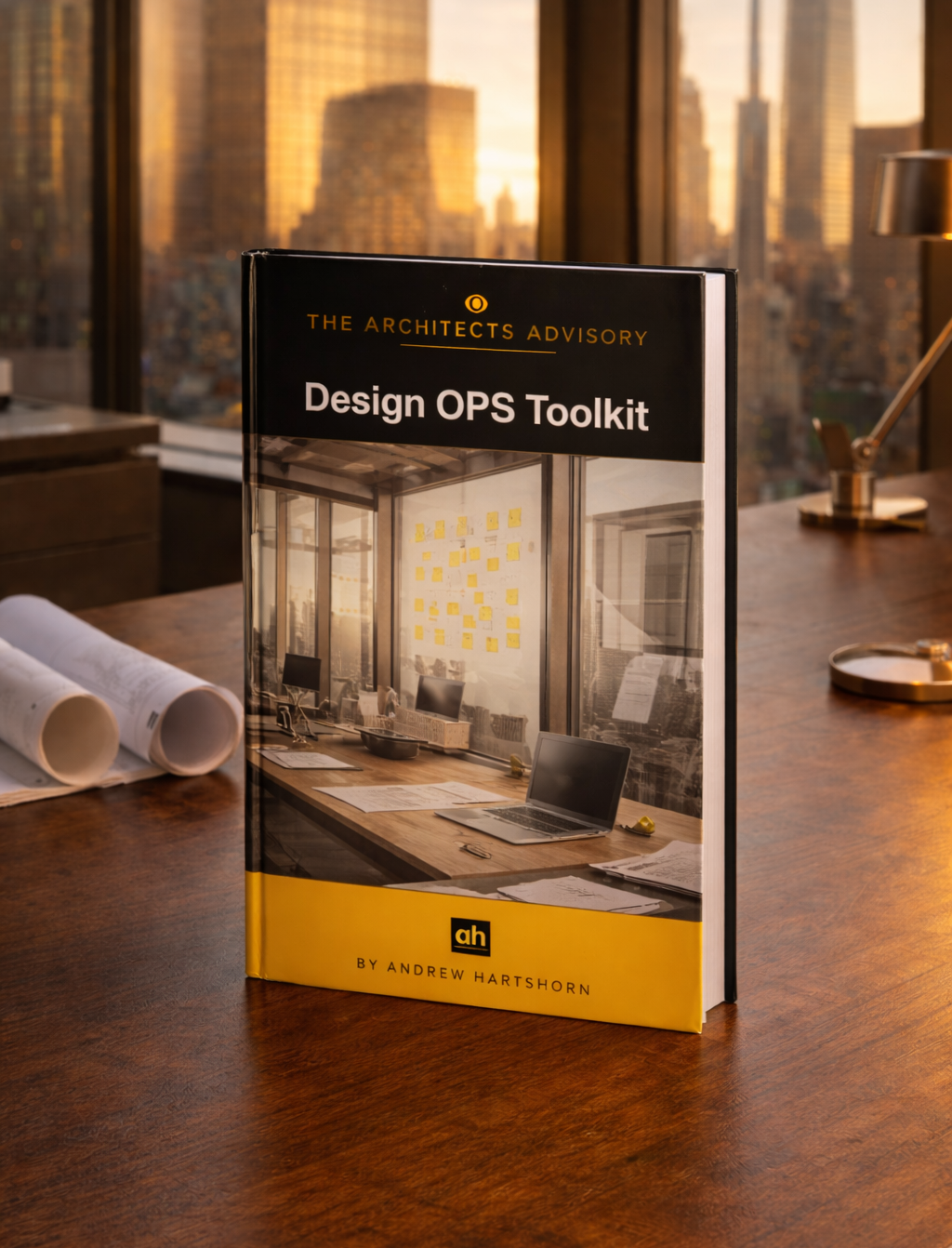



Design OPS™ Toolkit

This toolkit is designed for established practices that are profitable, but structurally dependent on the principal. This toolkit is designed to help you decide with discipline, not to push you toward deals or advisory before you are ready.

Most architecture practices do not fail because of poor work or lack of demand.


They fail quietly, through exhaustion, over-dependence on the founder, and decisions that were never designed to scale beyond one person.

Design OPS™ exists for practices that are already working, but are no longer sustainable for the person carrying them.


Who this is for

Design OPS™ is for architecture practice owners who have built a respected, profitable business — but feel trapped by it.

The work is good.
The team is capable.
The practice looks successful from the outside.

Yet inside, decisions bottleneck at the top, issues escalate unnecessarily, and momentum depends on the founder being present.

If the practice struggles to operate without you, it is not a leadership failure.
It is an operational design problem.

This toolkit is not designed for

With bullets like:

  • Early-stage practices still finding product-market fit

  • Owners looking for motivation or quick fixes

  • Teams without decision authority to change structure

Design OPS™ is about redesigning how the practice works — not working harder within it.

What Design OPS™ actually does

Design OPS™ helps you identify where founder dependency exists, why it persists, and what must change for the practice to operate with clarity, consistency, and confidence — without constant oversight.

This is not about:

  • Adding bureaucracy

  • Installing new software

  • Writing endless SOPs

It is about redesigning how the practice functions, so leadership, accountability, and information flow work by design — not effort.


When this toolkit is appropriate

This toolkit is designed for you if one or more of the following are true:

  • You are involved in too many operational decisions

  • Projects only run smoothly with your oversight

  • Financial or project data arrives too late to influence outcomes

  • Senior staff defer decisions upward

  • Growth feels harder and riskier than it should

When these conditions exist, the issue is rarely people.
It is almost always structure.

When this toolkit is not appropriate

Design OPS™ is not for you if:

  • You want software recommendations

  • You are looking for detailed task lists or SOP libraries

  • You expect delegation without authority redesign

  • You are unwilling to change how decisions are made

This toolkit assumes intent, leadership maturity, and a willingness to redesign the business you have outgrown.


The real problem: founder dependency

Founder dependency exists when the smooth operation of the practice relies on your constant involvement.

It typically shows up in four areas:

  1. Decision dependency
    Decisions escalate upward even when others are capable.

  2. Information dependency
    Only the founder has a complete or timely view of performance and risk.

  3. Client dependency
    Relationships are personal rather than institutional.

  4. Problem dependency
    Issues are escalated instead of resolved at the appropriate level.

The more of these exist, the less scalable, resilient, and transferable the practice becomes.

The Design OPS™ Diagnostic

At the heart of the toolkit is a structured diagnostic that allows you to assess your current operational maturity across five areas:

  • Decision flow

  • Workflow design

  • Information and reporting

  • Accountability

  • Founder load

You score the practice honestly and see, clearly, where constraint exists.

Scoring insight:

  • 40–50: Strong operational foundation

  • 30–39: Functional but constrained

  • 20–29: Founder-dependent

  • Below 20: Structurally fragile

This is not judgement.
It is visibility.

The Four Layers of Design OPS™

Design OPS™ works across four interdependent layers. Weakness in any one places pressure on the others.

  1. Workflow design
    Clear stages, ownership, and handovers.

  2. Information flow
    The right information, at the right time, to the right people.

  3. Accountability structure
    Authority aligned with responsibility.

  4. Measurement and feedback
    Metrics that drive action, not explanation.

Operational maturity comes from alignment across all four — not excellence in just one.


What changes when Design OPS™ is applied

  • Decisions are made at the correct level

  • Escalation becomes the exception, not the norm

  • Information supports action, not firefighting

  • Senior staff own outcomes, not just tasks

  • The founder’s involvement adds value rather than prevents failure

Most importantly, the practice becomes less fragile and more valuable.



30 / 60 / 90 day focus

The toolkit concludes with a practical redesign rhythm:

  • First 30 days: identify unnecessary escalation and clarify ownership

  • 60 days: improve reporting and align authority

  • 90 days: step back from a defined area and test resilience

Progress comes from redesign — not effort.


What you receive

  • The complete Design OPS™ Toolkit (PDF)

  • Diagnostic framework and scoring guidance

  • Practical redesign focus for the next 90 days

  • A clear operational lens you can reuse repeatedly

Licensed for internal business use.


Closing

Operations should be designed, not endured.

Architecture practices apply rigour and discipline to client work — yet many fail to apply the same thinking internally.

Design OPS gives you a structured way to redesign how your practice operates, reduce dependency, and create space for leadership, growth, and long-term value.

This is not a subscription. It is yours to keep with lifetime access.

Price: ÂŁ495
Access: Immediate

This toolkit is designed for independent use. While the same thinking informs advisory work, Design OPS™ does not require further engagement to be valuable.

Get the Design OPS™ Toolkit